User types at a glance
Admin and Co-Admin roles
Admin and Co-Admin are roles that can be assigned to Managed Users, not separate user types. A user must first be a Managed User before they can be given either role. Managed Users with the Admin or Co-Admin role can manage the Box enterprise through the . They can perform actions unavailable to other users, such as managing security policies, running reports, and configuring integrations.Some applications require Admin-level permissions to operate. For example, a security application that monitors needs an Admin or a Co-Admin with reporting permissions.
Managed Users
Managed Users belong to your enterprise and consume a standard Box license. Each enterprise has a unique enterprise ID, and all Managed Users share that ID. They typically share the same email domain.External Users
External Users are collaborators from outside your organization — Box users whose accounts are not created from within your Admin Console and whose email addresses are not associated with your managed domain. They can belong to a different enterprise, or they can have a free personal Box account with no enterprise affiliation. Admins cannot manage External Users’ account settings or the content they own, but they can manage collaborations — including granting or revoking access to your enterprise’s content. External Users appear in the Admin Console under Users & Groups > External Users. An Admin can them to become Managed Users in your organization, provided they are not already part of another Box enterprise.Unmanaged Users
Unmanaged Users are Box users who:- Have unlicensed personal Box accounts acquired independently of an Admin or Co-Admin, and that do not belong to your Box organization
- Use email addresses from your domain or verified domains (domains owned or controlled by your organization)
Service Account
A Service Account is a programmatic user that represents your application in the Box enterprise. It authenticates server-to-server without login credentials, which makes it ideal for backend integrations and automated workflows. * One per enterprise; can manage enterprise settings and authorize applications.** One per authorized application; can own content and processes, and can create and manage app users.
When to use
- Content migration: Move content between on-premises systems and the cloud
- Event monitoring: Watch enterprise events for compliance or to trigger workflows
- Content distribution: Upload and share files with users regardless of their authentication status
- System integrations: Connect on-premises systems and devices to Box
- Content archiving: Store infrequently accessed content
Creation
A Service Account is automatically generated when an Admin your JWT or CCG application in the Admin Console. You don’t create it manually. Box assigns the Service Account an email address in the format:AutomationUser_AppServiceID_RandomString@boxdevedition.com
For example: AutomationUser_123456_6jCo6Pqwo@boxdevedition.com. The number between the underscores is the Service ID, which matches the ID in your app’s URL (for example, https://example.app.box.com/developers/console/app/123456).
You can find the Service Account email in the App Details tab of your app in the .
Viewing content
Only Primary Admins can view a Service Account’s content:- Open the in the Admin Console.
- Search for the application name.
- Right-click the result and select Log in to user’s account.
Co-Admins can’t log in as a Service Account. This mirrors how Co-Admins can’t manage each other.
Permissions and collaboration
The API endpoints a Service Account can call are determined by the configured in the . With the right scopes, a Service Account can perform Admin-level actions. A Service Account has its own folder tree, which starts empty. To give it access to existing content:- By email: Invite the Service Account using its assigned email address, just as you would invite any other collaborator.
- By API: Use the with the Service Account’s user ID (returned by the ).
space_amount parameter.
App User
An App User is a programmatic user that your Service Account creates through the API. Like Service Accounts, App Users don’t have login credentials and can only interact with Box through your application. Each App User gets their own folder tree, which gives you per-user content isolation. App Users are tied to the application that created them and can’t be transferred to another application.When to use
- Customer portals: Give clients or patients a place to access and store sensitive documents without needing a Box account
- Vendor portals: Distribute content like price lists, contracts, and marketing materials to partners, organized by vendor tier
- Branded applications: Build customer-facing features with per-user permissions, auditing, and — especially valuable for regulated industries like financial services and healthcare
- Identity mapping: Map users from your own identity provider (like Auth0 or Okta) to individual Box user accounts
Creation
Prerequisites: You need a JWT or CCG application that has been in the Admin Console, which gives you a Service Account. To create an App User, use the Service Account’s access token to call the . Set theis_platform_access_only body parameter to true — otherwise, a Managed User is created instead.
Box assigns each App User an email address in the format:
AppUser_AppServiceID_RandomString@boxdevedition.com
For step-by-step instructions and code samples, see .
Viewing content
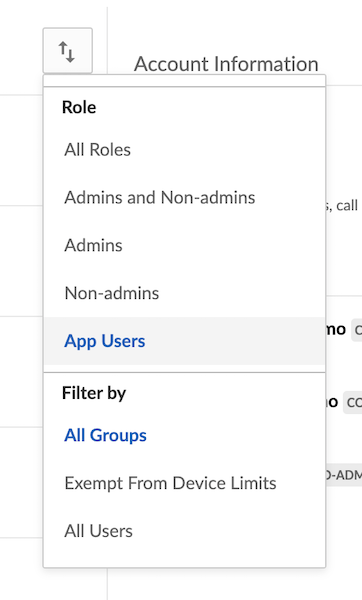
App Users are visible in two places in the Admin Console:- Users & Groups tab: Use the view options button, then filter by Role > App Users.
- Content Manager: Search for the App User by name or email to browse their folder tree.
Permissions and collaboration
App Users can’t see the Service Account’s folder tree or any other content unless you explicitly add them as a collaborator. Each App User has their own folder tree, which starts empty. To give an App User access to content:- By email: Invite the App User using their assigned email address.
- By API: Use the with the App User’s ID and an access token for a user who already has access to the target content.
Service Account vs. App User
Use this decision guide to pick the right approach for your application:As-User
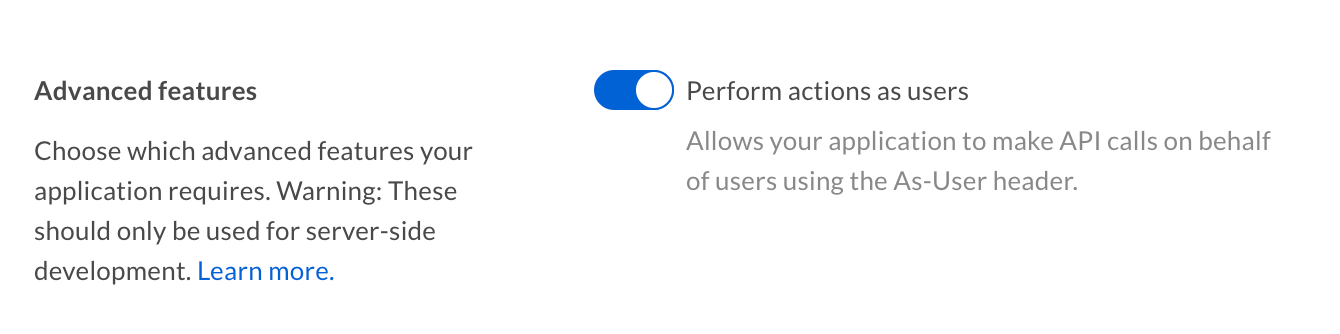
If you use OAuth 2.0, JWT, or CCG authentication, you can makeas-user calls to act on behalf of another user. Even though your application originally authenticated as yourself or as a Service Account, subsequent calls can impersonate a different user.
This is useful for automating administrative tasks like folder reorganization or employee provisioning. To enable as-user calls, turn on the appropriate scope in the .